JX Apparel Group
Production
Women's Coat Production Lead Times (2026): 36+ Data Points on Sampling, Bulk Timelines, Freight, and Where Delays Originate
By Ray Wang·May 31, 2026·13 min read
7-10 working days is the sample lead time at a specialist low-MOQ outerwear factory — against the 4-8 weeks a full sampling cycle takes at a generalist supplier.
A coat is one of the slowest garments to bring to market, and the gap between the timeline a factory quotes and the timeline a brand actually lives is where seasons get lost. The numbers below separate the production window you control from the freight and fabric windows you do not.
Key Takeaways
- Sample lead time at a specialist low-MOQ outerwear factory runs 7-10 working days, versus a 4-8 week full sampling cycle at a generalist supplier (JX Apparel Group).
- Bulk production runs 25-35 days after PP sample approval at a specialist coat factory, against a 30-90 day range for general China clothing production (JX Apparel Group).
- Ocean transit from China to the US West Coast measured 31.5 days in the week ending May 25, 2026 (Flexport Ocean Timeliness Indicator).
- The same index put China to the US East Coast at 50.2 days — roughly 19 days longer than the West Coast leg (Flexport).
- 30% of fashion supply-chain leaders call their chain "highly problematic with regular disruptions," against just 22% who call it efficient (Avery Dennison, 250 leaders).
- Only 13% of sourcing businesses report full visibility of their network including raw materials (QIMA Q1 2025 Barometer, 600+ businesses).
- 71% of chief procurement officers plan to increase their nearshoring share (McKinsey & BoF, State of Fashion 2026).
- One North American brand cut lead time by up to 60% through nearshoring (McKinsey & BoF, State of Fashion 2026).
- Chinese New Year 2026 closes factories February 15-23, with the effective disruption running weeks longer on both sides (China State Council calendar).
- MOQ at a specialist outerwear factory is 200 pcs per style/color, low enough to test a style before committing a full season's cash (JX Apparel Group).
- 45% of fashion executives name sourcing cost as their top economic pressure (McKinsey & BoF, State of Fashion 2026).
- Global inspection and audit demand rose 29% year over year in 2024 as buyers tightened oversight (QIMA).
1. The Realistic End-to-End Picture
Global apparel runs 12 to 20 weeks from tech pack to warehouse, and bulk alone in China spans 30 to 90 days depending on fabric and complexity. A coat collection does not move in a straight line from sketch to shipment, and the headline figures brands quote each other are rarely the ones they live by.
A specialist outerwear factory compresses the early stages. Sampling lands in 7 to 10 working days through its 7-10 day sampling capability, bulk runs in 25 to 35 days after PP approval, and the floor still moves around 2,000 pieces a day. Freight and fabric set the outer bound, not the sewing floor.
The structural lesson is plain: plan against the full window, not the production window. McKinsey reports one North American brand cut its lead time by up to 60% by moving production closer to market — proof that the calendar, not the stitch, is where the time hides.
| Metric | Value | Source |
|---|---|---|
| Global end-to-end apparel lead time (tech pack to warehouse) | 12-20 weeks | Apparel trade consensus |
| Bulk clothing production in China | 30-90 days | China sourcing consensus |
| Specialist factory sample lead time | 7-10 working days | JX Apparel Group |
| Specialist factory bulk after PP approval | 25-35 days | JX Apparel Group |
| Lead-time cut one North American brand achieved via nearshoring | up to 60% | McKinsey & BoF |
The wide China bulk range (30-90 days) reflects fabric sourcing and order size more than sewing speed.
2. The Sampling Stages: Proto, Fit, and PP
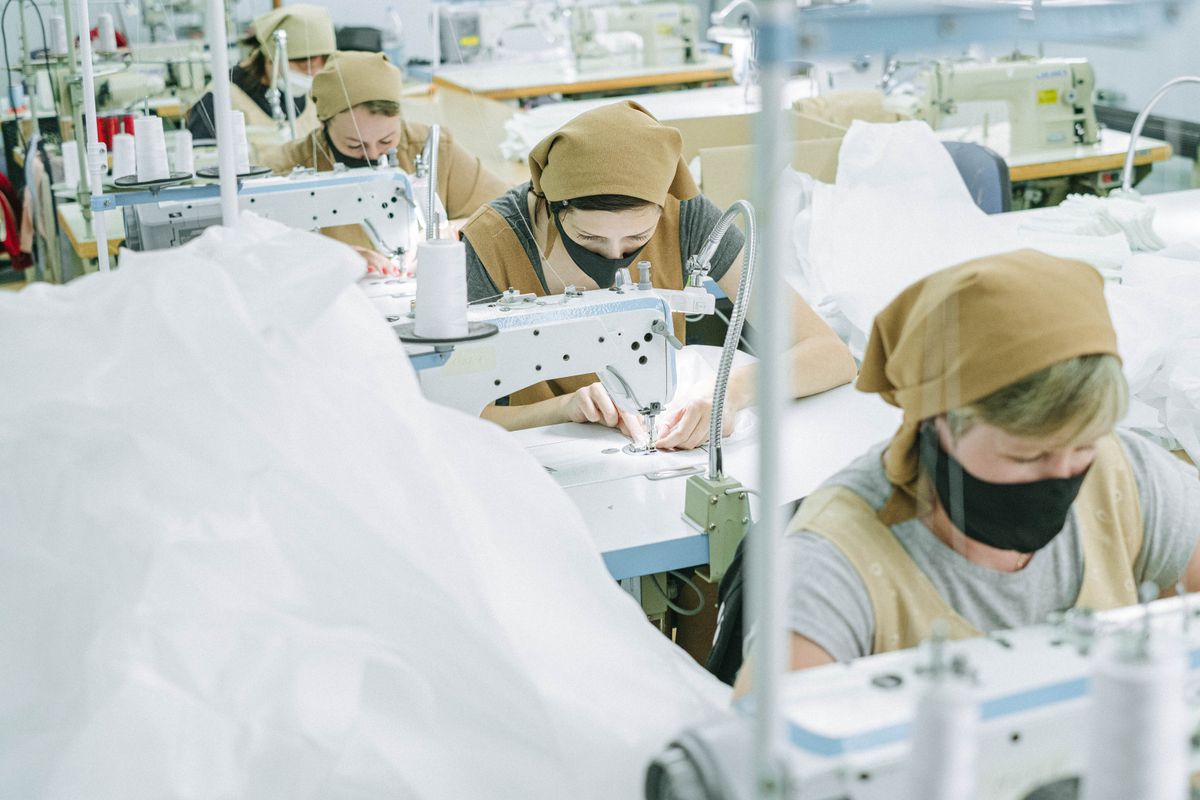
The full cycle from proto to a signed PP sample runs 4 to 8 weeks at a generalist supplier, and most tailored coats need two or three fit rounds along the way. Sampling is where small-brand calendars quietly slip, because each revision round is a new clock, not a continuation of the last.
A specialist factory can compress the whole cycle to 7 to 10 working days for a clean style. The sample costs 1.5 to 2 times bulk price and is refunded once the order is placed, and monthly capacity of 40,000 to 60,000 pieces means a sample is not waiting behind a production queue.
Build the calendar around the number of revision rounds expected, not a single optimistic figure. A proto lands in 7 to 14 days, each fit round takes another 7 to 10, and a custom-woven fabric can push any one of those samples toward 45 days on its own.
| Metric | Value | Source |
|---|---|---|
| Full sampling cycle (proto to PP approval) | 4-8 weeks | Apparel development consensus |
| Proto sample turnaround | 7-14 days | Apparel development consensus |
| Fit sample, per revision round (2-3 rounds typical) | 7-10 days/round | Apparel development consensus |
| Specialist factory sample cost (refunded on order) | 1.5-2x bulk price | JX Apparel Group |
| Custom woven fabric minimum (commission weaving) | 480 yard minimum | American Woolen Company |
Specialty silhouettes with custom fabric can extend any single sample to roughly 45 days.
3. Fabric and Trim: The Hidden Critical Path
For structured coats, the fabric mill — not the sewing floor — usually sets the delivery date. Custom-woven wool can take six to eight months to spin, and commission weaving carries its own yardage minimums before a single panel is cut.
The deeper problem is visibility. Only 13% of sourcing businesses can see their full network including raw materials, and just 54% know more than half their suppliers. A schedule cannot account for what a brand cannot see.
Lock fabric the moment PP direction is set, because every day the mill takes is a day bulk cannot start. The pressure to verify suppliers is rising too: global inspection and audit demand climbed 29% year over year in 2024, and disciplined planning alone can compress a lead time by 15 to 25%.
| Metric | Value | Source |
|---|---|---|
| Sourcing businesses with full supply-network visibility (incl. raw materials) | 13% | QIMA |
| Sourcing businesses that know more than half their suppliers | 54% | QIMA |
| Custom woolen yarn commission spinning lead time | 6-8 months | American Woolen Company |
| Global inspection & audit demand YoY (2024) | +29% | QIMA |
| Planning-driven lead-time compression | 15-25% | Apparel trade consensus |
The American Woolen figures are worst-case fully-custom benchmarks; most coat brands use mill stock or established blends that ship far faster.
4. Where Delays Actually Originate
Most blown delivery dates trace to a short list of predictable causes, and almost none of them are the sewing line. Disruption is now the norm: 30% of fashion supply-chain leaders call their operation highly problematic, against just 22% who call it efficient and responsive.
A quarter cite reduced agility to divert orders, and a quarter struggle to see disruptions in real time. The risks cluster around visibility and flexibility — exactly the areas a brand can plan for before a season starts.
Two-thirds of leaders say visibility technology is where they would invest next. The brands that hit their dates are the ones that name these risks up front and schedule around them, then verify the work with a disciplined 5-stage inline inspection process so a quality miss never forces a rerun.
| Metric | Value | Source |
|---|---|---|
| Leaders calling their supply chain "highly problematic with regular disruptions" | 30% | Avery Dennison |
| Leaders calling their supply chain "efficient and responsive" | 22% | Avery Dennison |
| Leaders citing reduced agility to divert orders as a top challenge | 25% | Avery Dennison |
| Leaders struggling to identify disruptions in real time | 26% | Avery Dennison |
| Leaders who would invest in visibility tech (e.g. RFID) to improve the chain | 65% | Avery Dennison |
5. The Chinese New Year Blackout
Factories close for the public holiday on February 15 to 23, 2026, but the real disruption runs weeks longer on both sides — wind-down before, and a slow ramp after. One date dominates the Chinese production calendar, and a brand that ignores it loses a season.
In the major manufacturing belts the effective closure averages over three weeks. If bulk has to run across this window, start it early or wait until March; there is no middle path that protects quality. A factory with a stable, retained workforce ramps back faster than the regional average.
The blackout is also reshaping sourcing geography. US fashion-buyer inspection demand in China fell 18% in 2025 while Southeast Asia demand jumped 42%, and the region now holds 33% of global apparel sourcing value — though China still anchors structured-outerwear capability.
| Metric | Value | Source |
|---|---|---|
| Chinese New Year 2026 public holiday | Feb 15-23, 2026 | China State Council |
| Average factory closure, Pearl River Delta (CNY) | 22-25 days | China sourcing consensus |
| US fashion-buyer inspection/audit demand in China YoY (2025) | -18% | QIMA |
| Southeast Asia inspection/audit demand YoY (2025) | +42% | QIMA |
| Southeast Asia share of global apparel sourcing value | 33% | McKinsey & BoF |
Buyers diversifying away from the CNY-dependent China calendar are accelerating Southeast Asia sourcing, but China still anchors structured-outerwear capability.
6. Freight: The Last and Longest Variable
Flexport's measured index puts China to the US West Coast at about a month and the East Coast and North Europe at roughly seven weeks each in mid-2026. Once goods leave the factory the clock is no longer the brand's, and ocean transit is the single longest leg of most coat calendars.
The destination gap is the trap. The West Coast figure of 31.5 days is the best case; the East Coast at 50.2 days and North Europe at 50 days are nearly three weeks longer for the same shipment.
Air freight collapses the ocean leg to 5 to 10 days, but for a 200-piece coat run the cost rarely justifies it. Book ocean space against the East Coast or Europe numbers, not the West Coast best case — freight variability, not sewing, is what turns an on-time PP approval into a late delivery.
Most brands plan their coat calendar around the factory's production window — 25 to 35 days — and treat freight as an afterthought. But ocean transit from China to the US East Coast runs 50.2 days, nearly as long as the entire production run. The freight leg, not the sewing floor, is where seasons get lost.
| Metric | Value | Source |
|---|---|---|
| Ocean transit China to US West Coast (May 2026) | 31.5 days | Flexport |
| Ocean transit China to US East Coast (May 2026) | 50.2 days | Flexport |
| Ocean transit China to North Europe (May 2026) | 50 days | Flexport |
| FCL fastest port-to-port, Shanghai/Shenzhen to US West Coast | 15-22 days | Freight-forwarder consensus |
| Air freight China to US (standard, incl. customs) | 5-10 days | Freight-forwarder consensus |
Flexport's figures are a measured weekly index; forwarder port-to-port ranges describe best-case scheduled service.
7. Planning Around Volatility: MOQ, Reorders, and the Calendar
71% of procurement leaders are moving production closer to their markets — the structural answer to lead-time risk is a shorter, more flexible chain. A low MOQ and fast reorders let a small brand test the calendar without betting a season on a single 90-day cycle.
A 200-piece MOQ for low-volume coat runs means a brand can produce 200 pieces, read the sell-through, and rerun the winners without committing a season's cash up front. Cost pressure makes that discipline matter: 45% of executives name sourcing cost as their top economic strain, and more than a third now use AI to manage supply-chain decisions.
Reverse-engineer every date from the retail drop, then add the freight leg first — it is the one that cannot be compressed. The same 60% lead-time cut that nearshoring delivered for a large brand is, for a small brand, available through a direct factory relationship with low minimums and fast reruns.
| Metric | Value | Source |
|---|---|---|
| Chief procurement officers planning to increase nearshoring share | 71% | McKinsey & BoF |
| Lead-time cut one North American brand achieved via nearshoring | up to 60% | McKinsey & BoF |
| Fashion executives naming sourcing cost as top economic pressure | 45% | McKinsey & BoF |
| Southeast Asia inspection/audit demand YoY (2025) | +42% | QIMA |
| Leaders who would invest in visibility tech (e.g. RFID) | 65% | Avery Dennison |
| Specialist factory MOQ per style/color | 200 pcs | JX Apparel Group |
Summary: Coat Production Lead Times by the Numbers
| Metric | Value | Source |
|---|---|---|
| Specialist factory sample lead time | 7-10 working days | JX Apparel Group |
| Specialist factory MOQ per style/color | 200 pcs | JX Apparel Group |
| Specialist factory daily output capacity | ~2,000 pcs/day | JX Apparel Group |
| Leaders citing reduced agility to divert orders | 25% | Avery Dennison |
| US fashion-buyer inspection/audit demand in China YoY (2025) | -18% | QIMA |
| Ocean transit China to US West Coast (May 2026) | 31.5 days | Flexport |
| Ocean transit China to US East Coast (May 2026) | 50.2 days | Flexport |
| Ocean transit China to North Europe (May 2026) | 50 days | Flexport |
| Air freight China to US (standard) | 5-10 days | Freight-forwarder consensus |
| FCL fastest port-to-port to US West Coast | 15-22 days | Freight-forwarder consensus |
| Chinese New Year 2026 holiday | Feb 15-23, 2026 | China State Council |
| Fashion leaders calling supply chain "highly problematic" | 30% | Avery Dennison |
| Fashion leaders who would invest in visibility tech | 65% | Avery Dennison |
| Businesses with full supply-network visibility | 13% | QIMA |
| Global inspection & audit demand YoY (2024) | +29% | QIMA |
| CPOs planning to increase nearshoring | 71% | McKinsey & BoF |
| Lead-time cut from nearshoring (one NA brand) | up to 60% | McKinsey & BoF |
| Southeast Asia share of global sourcing value | 33% | McKinsey & BoF |
| Global end-to-end apparel lead time | 12-20 weeks | Apparel trade consensus |
| Bulk clothing production in China | 30-90 days | China sourcing consensus |
Methodology and Sources
This guide combines measured primary data with the consensus stage-timeline ranges that recur identically across the apparel-manufacturing trade. Freight figures come from the Flexport Ocean Timeliness Indicator, a measured weekly index for the week ending May 25, 2026. Survey statistics come from Avery Dennison's Censuswide survey of 250 fashion supply-chain leaders, QIMA's Q1 2025 Supply Chain Barometer (600+ businesses) and QIMA sourcing-demand data, and McKinsey & BoF's State of Fashion 2025 and 2026. Chinese New Year 2026 dates follow the State Council's national holiday calendar. Factory sampling, bulk, MOQ, capacity, and sample-cost figures are JX Apparel Group's own production data.
- Flexport Ocean Timeliness Indicator
- Avery Dennison, Fashion Supply Chain Visibility 2025
- QIMA Q1 2025 Supply Chain Barometer
- QIMA Global Sourcing Trends (2024-2025)
- McKinsey & BoF, The State of Fashion 2026
- McKinsey & BoF, The State of Fashion 2025
- Chinese New Year 2026 factory shutdown (State Council calendar)
- American Woolen Company (mill service terms)
- Dimerco freight transit times
- Tonlexing air freight guide 2026
- JX Apparel Group factory production data
The five stage-timeline ranges retained — end-to-end window, China bulk window, full sampling cycle, Pearl River Delta CNY closure, and planning-driven compression — are classified consensus ranges: each appears with the same values across three or more independent industry sources, but no single organization publishes them as primary measured research.
Last updated: May 2026. Updated quarterly as freight and sourcing data shift.
R
Written by
Ray Wang
Women's outerwear manufacturing specialist with 13 years of experience producing wool, cashmere, and down coats for fashion brands across Europe and North America at JX Apparel Group in Jiaxing, China.
Related Insights
Production
Shearling Jacket Manufacturer for Small Brands (2026): 42+ Data Points on Sourcing, MOQ, and Construction
12 min readProduction
Cocoon Coat Manufacturer for Small Brands Statistics (2026): 40+ Data Points on Oversized Patterning, Grading, and Fabric Weight
14 min readProduction
Trench Coat Manufacturer for Small Brands Statistics (2026): 45+ Data Points on Gabardine Specification, Water-Repellency Testing, and MOQ
15 min readReady to Source?
Work with a Factory That Specialises in Premium Outerwear
20+ years of team experience in mid-to-high-end women's coats and jackets. Low MOQ from 200 pcs. Cashmere, wool, silk capabilities.
Get in Touch →